daniel’s theories
Geopolitics9
ClearPaperDigital Science10 July 2025
Deepseek and the New Geopolitics of AI
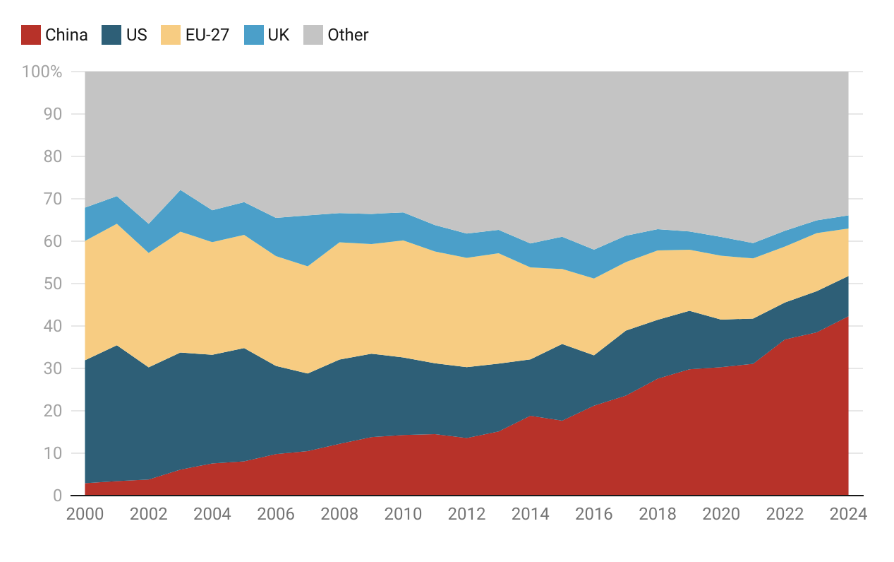
Artificial Intelligence (AI) is no longer a peripheral concern—it is a central force reshaping societies, economies, and global dynamics. As AI permeates every facet of life, from workplace automation and healthcare to surveillance and personal freedoms, its potential to yield both transformative benefits and significant harms hinges on how access to its development and knowledge is distributed. This report examines the current global research landscape of AI, focusing on four pivotal regions: China, the EU-27, the UK, and the US. Through comparative analysis, we identify key trends and geopolitical shifts, including the growing strategic importance of AI, the US's declining dominance in favour of China’s rapid ascent, and the pivotal role of international research collaboration. Notably, China emerges as the world’s central AI collaborator with a deepening talent pool and expanding research output. The UK, while smaller in scale, punches above its weight in terms of impact, while the EU-27 exhibits strong internal collaboration but limited external engagement. Our findings underscore that the trajectory of AI development—and its societal consequences—will be shaped not just by technological breakthroughs but by global patterns of collaboration, competition, and knowledge governance.
PaperarXiv.org28 January 2025
Understanding the importance of SHAPE to the UK research ecosystem
The UK has a long-established reputation for excellence in research across a broad range of fields, but in recent years, there has been greater emphasis on STEM investment and greater recognition of the UK's success in STEM. This paper examines the relative strengths of SHAPE disciplines and demonstrates that the UK's SHAPE research portfolio outperforms the UK's STEM research, for each international benchmark considered in this work. It is argued that SHAPE research is becoming increasingly important as a partner to STEM as the widespread use of technology creates societal challenges. It is also argued that the strength of UK SHAPE is the basis of a strategic advantage for UK research.
TalkDeSci Foundation8 May 2023
Scholarly Communication at the Dawn of Exponential Revolution
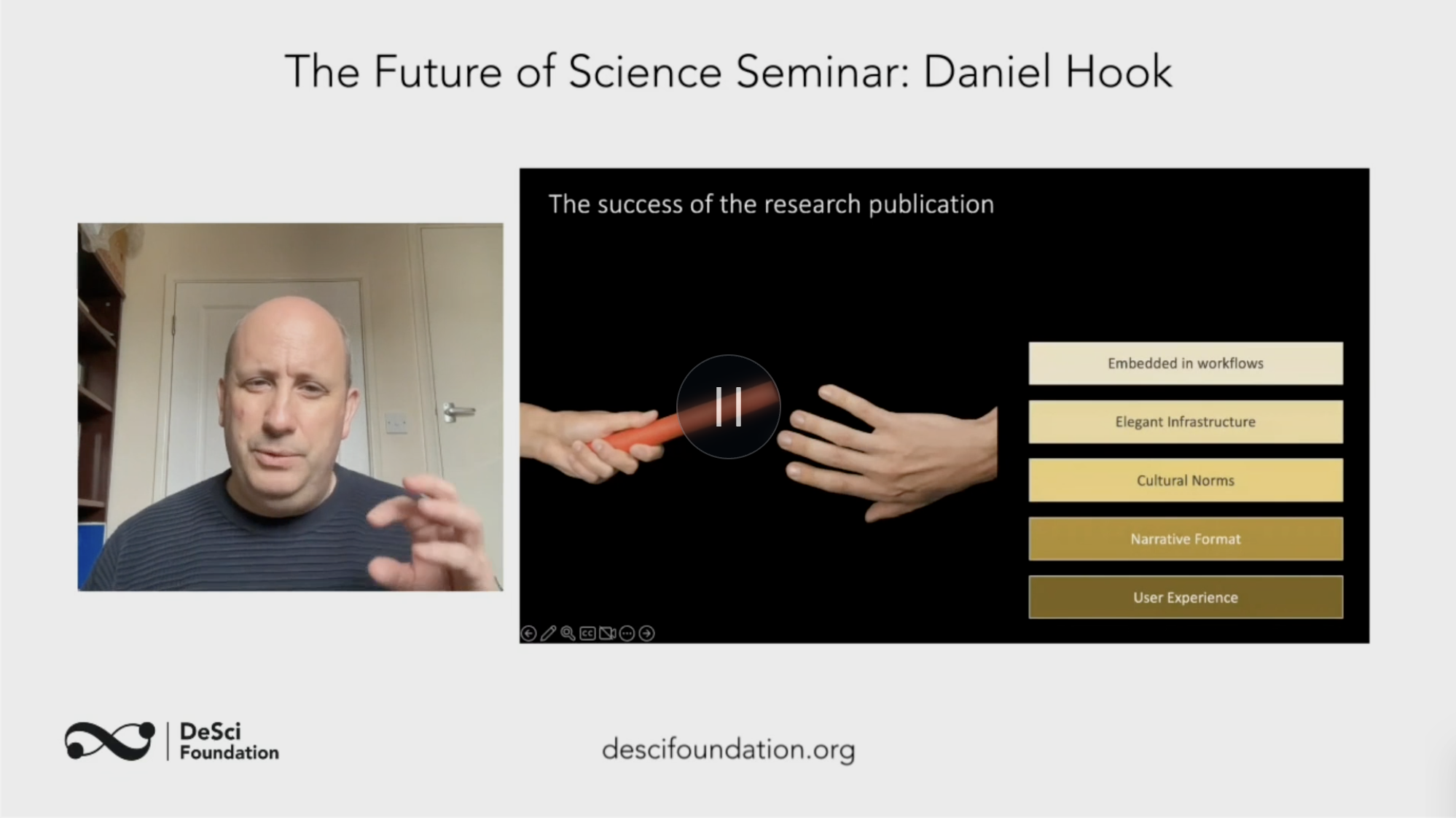
It is clear that we are entering a new phase of technological growth: Not an industrial revolution of the type that we have seen before but an exponential revolution awaits with all the challenges and wonders that entails. An abundance of data coupled with sophisticated tools for both capturing and analysing data has transformed research over the last half century. And yet, scholarly communication is still reliant on 17th Century technology. In this seminar we examine why this is the case and what the future of scholarly communication could look like.
ArticleDigital Science18 October 2022
Five measures that chart the rise of Chinese influence in global research
If China continues on its current path, within a decade it will be vying for pre-eminence in its ability to influence the global research conversation.
ArticleLSE Impact - Understanding impact and practice in academic research1 September 2020
From Impact to Inequality: How Post-COVID-19 government policy is privatising research innovation
Post-COVID-19 government policy has included an increase in investment in the UK’s research sector. However, Daniel Hook finds that the emphasis on the impact of this research means that longer-term, less measurable, blue skies research is being pushed into the private sector. Not only is blue skies research the key driver of technological change, but
PaperDigital Science11 February 2019
Japanese Collaboration in the Global Research Landscape
Japan finds itself in a difficult position regarding ongoing funding for research in turbulent financial times but is starting to be much more active on the world stage. The indicators show a positive future for Japan if the leadership of top researchers can cascade down to the broader research population and make Japan much more outward bound in its research collaboration landscape. If this is supported by funders with innovative approaches to funding and incentivising Japan’s increased engagement and visibility on the world research stage then Japan looks forward to a prosperous and important place in the global knowledge economy.
PaperDigital Science17 September 2018
The Fourth Age of Research in Australasia
In this report, we take a new look at international collaboration patterns focussing on the Australasian region. More than other regions in the world, Australasia has always been outward looking and its research community has sought to connect itself with international partners. This is, no doubt, in part due to the geographical location of the continent but other factors play a role including the heavy development of Australasia’s research base in the last few years and the importance and power of that research base as an economic driver for the region. More recently, a coherent focus has been taken across the region to international engagement. We have used Digital Science’s Dimensions database together with a filter of high-quality journals provided by the Nature Index journal list to explore the national and international collaboration landscape in Australia and New Zealand.
PaperDigital Science8 May 2017
Digital Research Report: The Landscape of Climate Research Funding
The USA government proposes policy and funding changes around environmental protection and climate research. As is often the case, it will be difficult to assess the impact until years after the policy has been enacted. However, funding data provide us with a more proximate bellwether than the traditional research analytics. In this report, we profile the balance of ‘climate research’ investment and note its impact on a diverse research portfolio that runs from ecology and atmospherics to economics and public health. We explore the use of funding data as an analytical source, track the growth of ‘climate change’ as a topic and differentiate this from ‘global warming’. We also disaggregate funding across fields of research and demonstrate a research shift from global climate to biological impact and adaptation and, now, towards response and mitigation. The data highlight the ratio between a relatively small pool of research funds and its support of a much greater infrastructure for monitoring, regulation and response. The USA is identified as the largest single source of research grants, although European funds are growing rapidly. The USA provides key support and data worldwide, and may have been agile in shifting from background research into adaptation and mitigation. USA policy change could undermine many other efforts. The global research effort is shared because the climate is shared; so should be the responsibility to sustain these commitments.
PaperDigital Science18 May 2016
Examining Implications of Brexit for the UK Research Base
Independent data research by Digital Science reveals that leading British institutions and companies, including the University of Cambridge, the University of Oxford, Rolls-Royce, BT and the BBC, could stand to lose significant EU funding for R&D if the UK government doesn’t plug the gap.






* ordered by publication date, which is not the same as when any of it was written.