ArticleResearch Agenda7 September 2026
The Waymo effect: how AI is quietly making research less collaborative
How frictionless technologies teach us to prefer our own company – and why research leaders should worry.
ArticleResearch Agenda7 September 2026
How frictionless technologies teach us to prefer our own company – and why research leaders should worry.
More recently
ArticleSymplectic10 June 2026
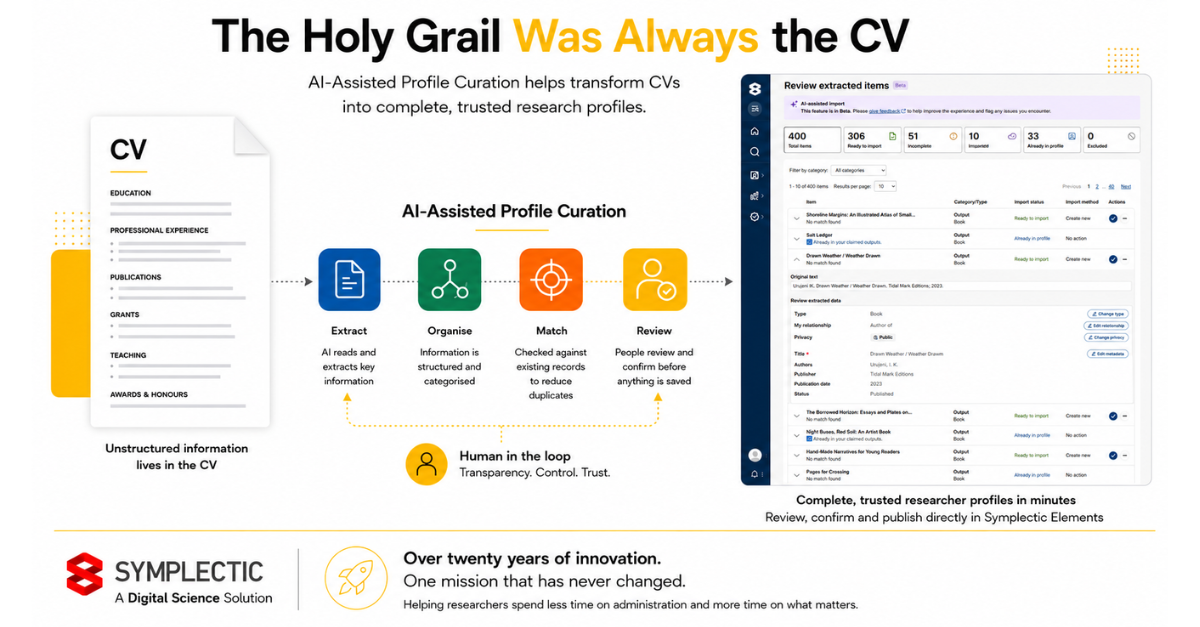
How AI is helping us solve a challenge that has limited research information management for more than two decades
WritingDavidWorlock.com15 May 2026Password required
In this interview, Dr Daniel Hook discusses the growing influence of AI, the challenges of information overload, and the future of digital research and innovation. Watch the interview: www.patreon.com/davidworlock/
ArticleHoltzbrinck8 April 2026
Language is a technology we rarely examine — a cage that shapes thought from the inside. Every communication tool rebuilds that cage: the printing press, keyword search, and now LLMs. But where earlier cages had visible bars you could trace and interrogate, the walls of a model's training data are invisible. Fluency feels like liberation. The cage has always had architects; what's new is that we can no longer see them.
ArticlePhysics World31 May 2024
Daniel Hook, chief executive of Digital Science, reflects on his career developing information tools for researchers
ArticleDigital Science2 May 2024
Digital Science CEO Daniel Hook explores how the Barcelona Declaration will push forward openness and transparency, as well as innovation to benefit the scholarly record.
ArticleDigital Science30 October 2023
Large Language Models are known to hallucinate facts. While there is an active debate on whether this is a bug or a feature, the fact remains that we don't understand AI to the level where we can get LLMs to trace back to their motivation for making a specific pronouncement. Thus, LLM providers who work in the science space are faced with a challenge - they want to leverage the new capabilities of LLMs but need somehow to create references back to the original work, but in forcing an LLM to work in a way that creates referencability, one destroys its ability to create a synthesis from multiple sources, creating a fundamental playoff between specificity and synthesis.
Index
20236
20226
20204
20195
20161
20071
* ordered by publication date, which is not the same as when any of it was written.