daniel’s theories
20199
ClearArticledirect.mit.edu5 December 2019
Dimensions: Bringing down barriers between scientometricians and data
Until recently, comprehensive scientometrics data has been made available only in siloed, subscription-based tools that are inaccessible to researchers who lack institutional support and resources. As a result of limited data access, research evaluation practices have focused upon basic indicators that only take publications and their citation rates into account. This has blocked innovation on many fronts.
ArticleIQOQI Vienna3 September 2019
Rethinking Academia 1: Daniel Hook - Deconstructing research: a future for scholarly communication
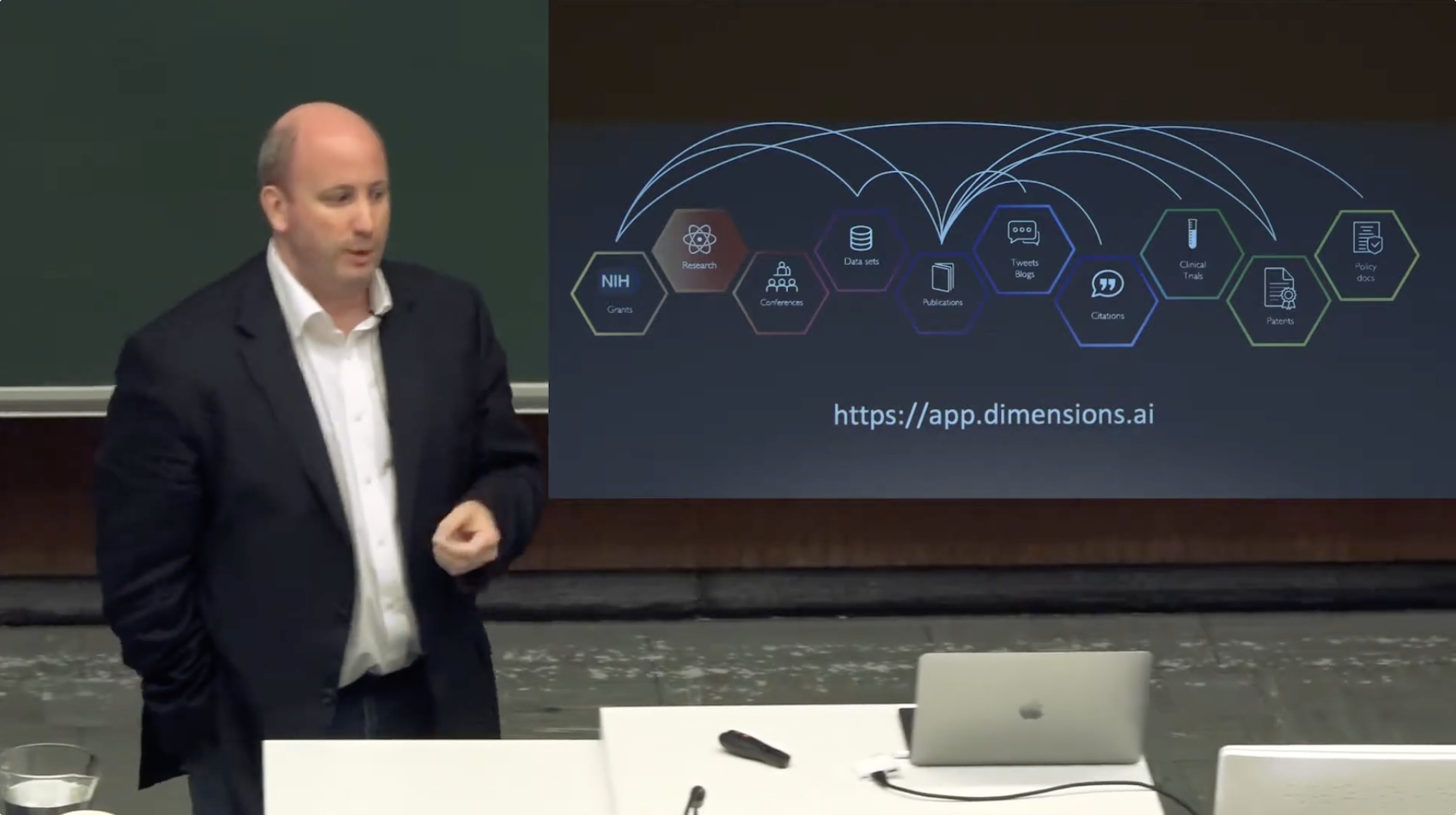
The research paper has been around for more than 350 years and has become embedded in scholarly research as the centre of scholarly communication. However, as the fundamental relationships that define research are changing, the core of scholarly communications is under increasing pressure to change. This talk defines and discusses these fundamental relationships, the pressures that they are experiencing and examine how that could change scholarly communication.
PaperPLOS ONE28 May 2019
Perception, prestige and PageRank
Academic prestige is difficult to quantify in objective terms. Network theory offers the opportunity to use a mathematical formalism to model both the prestige associated with an academic and the relationships between academic colleagues. Early attempts using this line of reasoning have focused on intellectual genealogy as constituted by supervisor student networks. The process of examination is critical in many areas of study but has not played a part in existing models. A network theoretical “social” model is proposed as a tool to explore and understand the dynamics of prestige in the academy.
PaperDigital Science1 April 2019
Precision Medicine, An International Perspective
This report provides a brief overview of the area of personalised and precision medicine since the turn of the millennium, highlighting key areas of development in publication activity. It has been produced in celebration of the Russian-German Science Dialogue and in combination with Merck’s 120th Anniversary in Russia. As a result, we pay particular attention to these countries.
ArticleThe Scholarly Kitchen11 March 2019
Openness: An interview with Daniel Hook, CEO of Digital Science
Robert Harington interviews Daniel Hook, CEO of Digital Science, discussing openness and findings from his recent report entitled The Ascent of Open Access.
ArticleLSE Impact - Understanding impact and practice in academic research11 March 2019
The Open Tide – How openness in research and communication is becoming the default setting
Open Access to research findings is often presented as an end unto itself. However, the ethos of open access, to enable a greater sharing and utilisation of research knowledge, suggests a more complex network of scholarly communication. Presenting the findings of a recent report on the development of Open Access, Daniel Hook explores how the
PaperDigital Science11 February 2019
Japanese Collaboration in the Global Research Landscape
Japan finds itself in a difficult position regarding ongoing funding for research in turbulent financial times but is starting to be much more active on the world stage. The indicators show a positive future for Japan if the leadership of top researchers can cascade down to the broader research population and make Japan much more outward bound in its research collaboration landscape. If this is supported by funders with innovative approaches to funding and incentivising Japan’s increased engagement and visibility on the world research stage then Japan looks forward to a prosperous and important place in the global knowledge economy.
PaperDigital Science24 January 2019
The Ascent of Open Access
This report is an analysis of the Open Access landscape since the turn of the millennium. It compares the leading countries for research outputs with those producing the most Open Access papers over a 16-year period, as well as Open Access collaboration trends.





* ordered by publication date, which is not the same as when any of it was written.